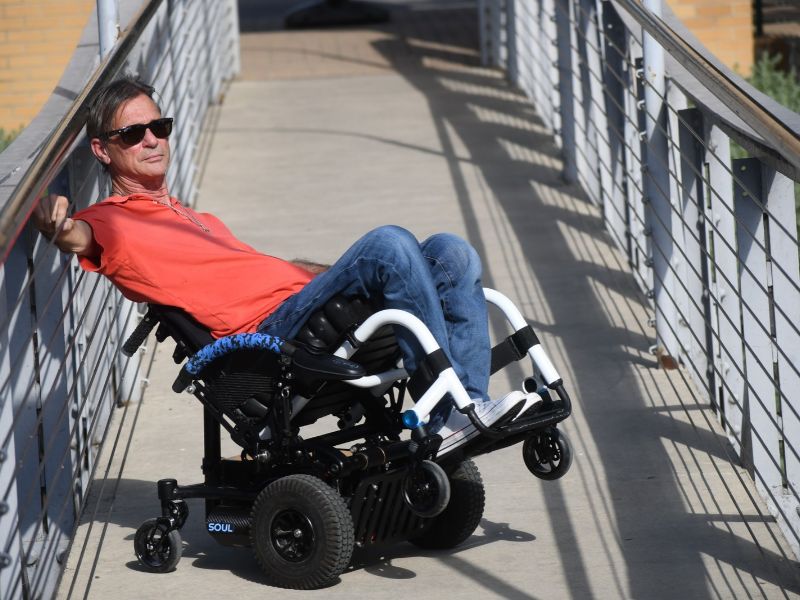
For many aging manual wheelchair users, maintaining independence at home becomes more challenging as the physical demands of self-propulsion increase. Shoulder pain, fatigue, and reduced endurance can make routine activities—from preparing meals to doing laundry—more difficult, sometimes creating a greater need for assistance.
At Soul Mobility, we believe technology can help address these challenges without requiring users to abandon the seating and positioning of their familiar manual wheelchairs. Our Power-Flex power-assist system combines powered mobility with a compact design to help users navigate their homes and manage everyday tasks with less physical effort.
Innovation Begins With Experience
My perspective on mobility comes from nearly four decades of personal experience as a manual wheelchair user. After sustaining a spinal cord injury in a motorcycle accident in 1986, I learned firsthand how much physical effort and adaptation go into navigating everyday life from a wheelchair.
My experiences also shaped my career as an inventor in the complex rehabilitation technology (CRT) industry. Over time, I recognized that the cumulative effects of self-propulsion could make everyday activities increasingly demanding for long-term manual wheelchair users.
Some individuals experience shoulder pain or fatigue that limits their ability to manage household responsibilities. Others find that getting around consumes so much energy that they have less left for cooking, cleaning, or spending time with family. These observations helped inspire Power-Flex, a solution designed to reduce the physical demands of mobility while preserving the benefits of a familiar wheelchair.
Making Everyday Tasks Easier
Power-Flex transforms a compatible rigid manual wheelchair into a joystick-controlled powered mobility solution in less than 30 seconds, without tools. The system replaces the wheelchair's wheels, allowing users to navigate their homes without continuously pushing.
For someone experiencing shoulder pain or reduced endurance, this can make a meaningful difference. Tasks such as bringing groceries inside, moving laundry, preparing meals, and unloading a dishwasher require energy and maneuverability. Power-Flex helps users move around their homes with less physical effort, while its joystick control frees one hand to assist with these activities.
Its compact design and zero-turning-radius maneuverability also help users navigate tight indoor spaces and move around furniture. By reducing the effort required to get around, Power-Flex can help users conserve energy for the household activities and personal interests that matter to them.
Supporting Aging in Place
Remaining at home is an important goal for many older adults, and mobility equipment can play a significant role in supporting that choice. The ability to navigate familiar spaces and access everyday areas can help people maintain established routines.
Power-Flex preserves the familiar seating configuration and ride height of a compatible manual wheelchair, helping users maintain access to tables, sinks, desks, and other areas. The system also includes suspension to help manage uneven surfaces and manual tilt to support repositioning and pressure management.
For caregivers and family members, technology that supports independent mobility may reduce the physical assistance required for some daily activities. Although Power-Flex cannot eliminate every need for assistance, it offers another option for individuals who want to manage more of their daily lives independently.
Rethinking Mobility as Needs Change
Traditional power wheelchairs remain essential for individuals who require comprehensive powered mobility or specialized seating. However, not every manual wheelchair user experiencing the effects of aging needs to transition to a traditional power wheelchair.
Power-Flex offers an alternative for individuals who could benefit from powered mobility while retaining their existing wheelchair seating and positioning. This reflects an important principle in rehabilitation technology: solutions should be tailored to individual needs rather than assume everyone follows the same path as they age.
Power-Flex is designed for compatible rigid manual wheelchairs. An individual's physical capabilities, seating requirements, transfer methods, home environment, and transportation needs should be considered during an evaluation. An assistive technology professional (ATP), occupational therapist, or physical therapist can help determine whether the system is appropriate.
Independence Is the Goal
Developing meaningful mobility solutions requires listening to wheelchair users and collaborating with clinicians, equipment providers, and manufacturers. At Soul Mobility, we believe people who use mobility equipment should play a central role in shaping the technology designed for them.
After nearly 40 years of using a manual wheelchair, I understand how much independence depends on the ability to manage everyday life. As the population ages, mobility innovation must address more than getting from one destination to another. It must also consider how technology can help people maintain control over their daily lives, remain active in their homes, and reduce reliance on others for routine activities.
At Soul Mobility, we believe the right technology can help people preserve that independence. Power-Flex was developed with this goal in mind: reducing the physical demands of mobility so users can devote more energy to living their lives.
Because meaningful mobility isn't just about getting around. It's about preserving the ability to live life on your own terms.

.jpg "A New Community Hub Helps Seniors Navigate Local Healthcare")